



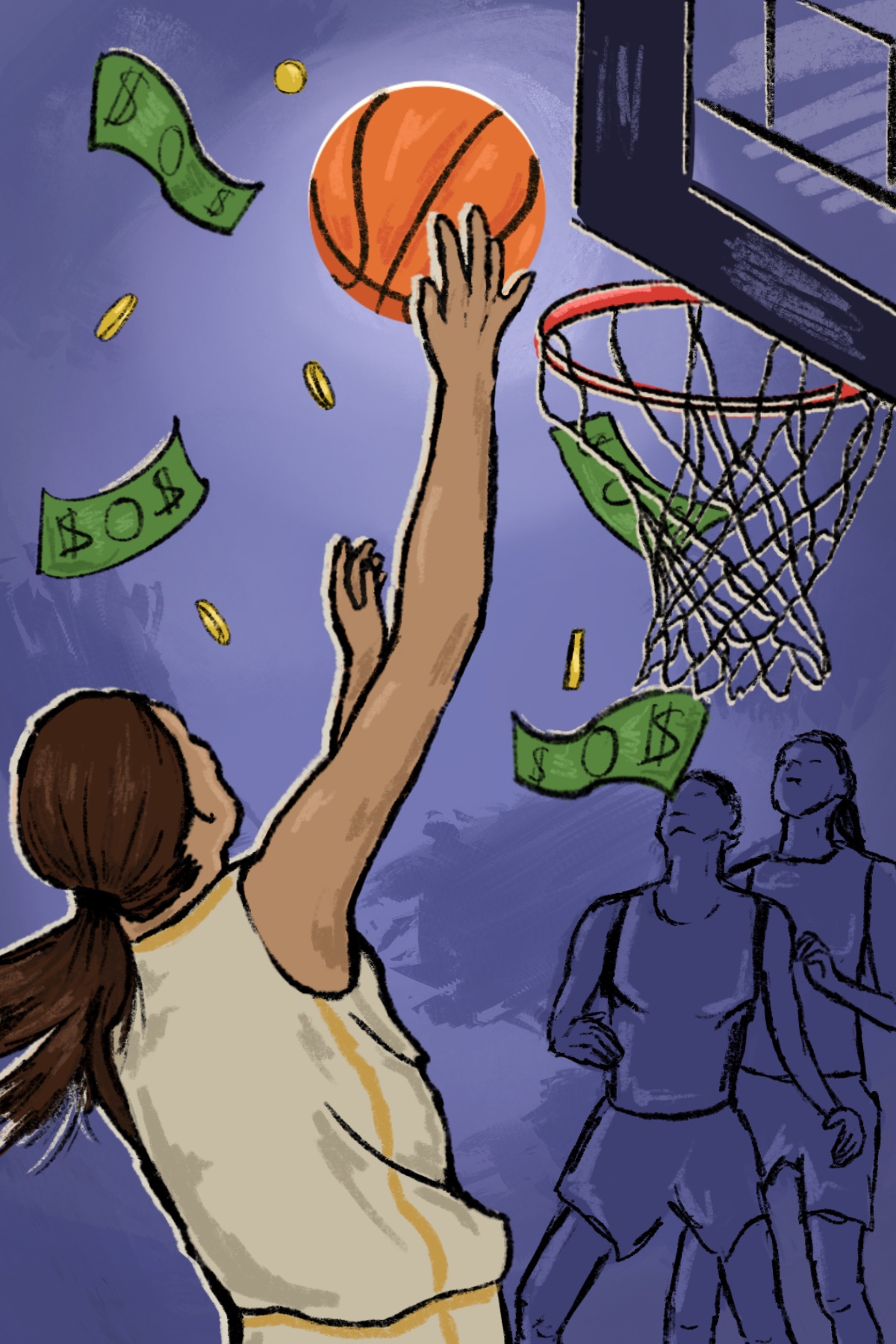
NIL, otherwise known as name, image and likeness, refers to a player’s right to control how their image is used in the media, commercially.
For some college athletics programs, NIL is beneficial for both their program and their players, allowing them to build their brand.
However, for most programs like Northern Kentucky University and other mid-majors, NIL is crippling their ability to compete in an increasingly business-oriented college athletics landscape.
In 2021, the Supreme Court ruled in favor of NIL, allowing student-athletes to receive compensation for their NIL rights.
What started as a way for student athletes to profit from their personal brand and to make money from endorsements, sponsorships and social media promotions has now turned into schools paying the highest bid for the top players. Before schools could pay players directly, NIL collectives raised money from donors, alumni and fans to pay for the players.
NIL reached a boiling point in 2022 when Miami University star Isaiah Wong’s NIL agent, Adam Papas, came out and said, “If Isaiah and his family don’t feel that the NIL number meets their expectations, they will be entering the transfer portal tomorrow.”
In an effort to better regulate NIL, the NCAA’s House v. NCAA settlement that passed over the summer has now allowed Division I schools to directly compensate student athletes through a revenue-sharing model. Each school has an annual cap of $20.5 million across all sports, funded by revenue from the athletic department. The annual cap is expected to increase to $32 million over the next 10 years.
As a result, players like Arch Manning (CFB) and AJ Dybantsa (CBB) have been able to grow their net worth to an astonishing $5.5 million (Manning) and $4.1 million (Dybantsa), according to On3’s NIL valuation rankings.
The schools that have been and will be impacted the most by the settlement are the most powerful and influential conferences, including the Big Ten Conference, the Big 12 Conference, the Atlantic Coast Conference (ACC) and the Southeastern Conference (SEC). This is because, according to Associated Press (AP), their NIL money comes from things like media rights, ticket sales and other sponsorships.
In addition, the House v. NCAA bill could hurt non-revenue sports and walk-ons. According to NIL-NCAA.com, “Football and Men’s basketball account for over 90% of team-specific revenues at most Power Conference schools, and athletes on these two teams will be the major beneficiaries of revenue sharing.”
This wouldn’t change for mid-majors like NKU, because starting out, two big focuses will be men’s and women’s basketball. Christina Roybal, NKU vice president and director of athletics, said the goal would be $300,000 to $500,000 for each program.
Smaller programs are facing the consequences of NIL as they struggle to retain players due to having a smaller budget compared to high-major programs. Since April 2024, athletes have been able to transfer as many times as they want without penalty. This has led to many mid-major players leaving to obtain better opportunities and more exposure.
For example, NKU star guard Marques Warrick played for the Norse from 2020 to 2024. He is one of the most decorated student-athletes in NKU history, winning many individual awards. Most notably, he reached 2,246 career points, the most in NKU history. Warrick left the university in March of 2024 for bigger programs, ultimately landing in the SEC at the University of Missouri.
Of the 15 Horizon League men’s basketball players who earned first, second or third team honors during the 2024-2025 season, nine transferred and six graduated, leaving no returning players for the 2025-2026 season.
During the 2016-2017 season, before NIL and the transfer portal changed, 10 players earned first and second-team honors. Of those 10, two transferred, three graduated and five players returned the next season.
For mid-major programs, it can take years to build a squad suitable enough to compete. However, after the changes to NIL, high-major programs can simply reload their teams year after year, making it increasingly difficult for mid-major programs to keep pace.
The lower retention rate at schools can be partially attributed to the new transfer portal rules. Nevertheless, it has become very clear that NIL is a primary reason for players transferring. In this modern college basketball landscape, it’s hard for mid-majors to consistently build their program if their best players are transferring every single year.
NCAA College Basketball Rule Changes
The NCAA Playing Rules oversight panel approved new rules and changes for men’s basketball to help improve the flow of the game, with the most significant change being to coaches’ challenges.
A coach can call a challenge at any point in the game to review out-of-bounds calls, interference/goaltending and whether a secondary defender was in the restricted area. Teams must have a timeout to challenge. If successful, teams will receive one additional challenge for the rest of the game. If unsuccessful, the team loses the timeout and their ability to challenge for the rest of the game.
Any player who uses the backboard for an advantage will be called basket interference.
Contact to the groin area can now be called a flagrant one foul; previously, contact to the groin area could only be called as a common foul or a flagrant two foul, which led to ejection.
If one shot clock becomes inoperable, the other shot clock will remain on. Previously, both shot clocks would be turned off.
New changes to the continuous motion rule now allow an offensive player to finish their shooting motion or pivot move after being fouled. This rule change now allows a player to complete the step they are on and finish their shot.