

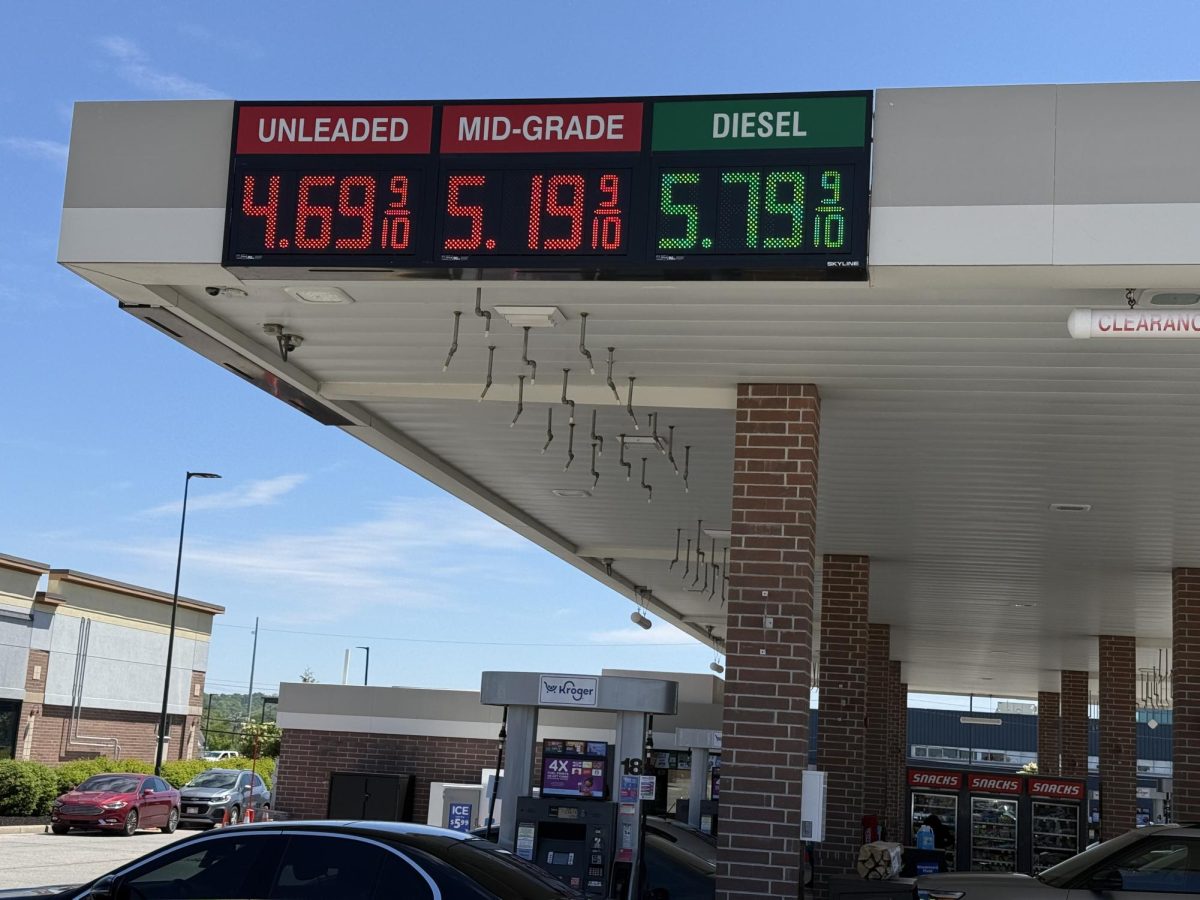
“Overwhelming” is how students at Northern Kentucky University describe rising gas prices in the Tri-State.
University students’ budgets are tight, and the whiplash of gas prices caused by the ongoing conflict in Iran across the United States has been an ongoing concern for students nationwide and in the NKU community.
“It’s been difficult to navigate – with other daily expenses, rent and food, the additional stress of gas prices has been overwhelming,” NKU senior Kate Patterson said.
According to GasBuddy, a tracker that follows gas prices and their fluctuations across the United States, both Cincinnati and Northern Kentucky gas averages were listed at $3.85 on April 8.
That marks a steady increase from the $2.628 that was reported on Feb. 28, the day the U.S. military began strikes on Iran.
Reported gas prices around NKU’s campus, which had reached $4.99 in the past weeks, have now dropped slightly to an average of $4.89, although prices remain high and fluctuate across the Greater Cincinnati/Northern Kentucky region.
Patterson, who has lived off campus since 2023, has watched prices soar and worries about other students, reflecting on her own time at NKU.
“As an underclassman, I didn’t have a car,” Patterson said. “I wasn’t as worried about a parking pass or gas prices, but now – I couldn’t imagine having a car all four years.”
Junior Claire Hummel is a commuter student who has lived at home since the start of her time at NKU.
“I’ve enjoyed having a car for school, it lets me travel back and forth to balance time between my studies and family,” Hummel said.
Gas prices are slightly higher than the national average, at $4.67, according to GasBuddy.
“I am worried about the sudden spikes,” Hummel said. “What if gas keeps going up?”
But these increases affect not only commuter students in the local area but also those who live on NKU’s campus. A common misconception is that those who live on campus have fewer expenses than those who commute. Although many of those expenses are allocated to housing and meal plans, students are not without worries about gas prices.
Senior Michael Kirby said gas prices have been on his mind as a vehicle is the only way to visit home and for the purpose of errands.
“I’m from Louisville, I live on campus, but my car is my only way to get back. When prices are high, I have to rethink when to go home,” Kirby said.
These students’ accounts are a small picture of a much larger student population across the region, ever affected by the increases and wary of larger surges at a local level.
“It’s not practical to spend $50 for a trip home and back, so recently I’ve just been trying to stay on campus as much as I can, but I’d like to visit soon,” Kirby said.
But at the national level, students are increasingly having to restrict and draw greater attention to their budgets for more than just gas prices. Rent and food prices have surged in the United States, according to the Urban Institute’s ‘American Affordability Tracker, showing that nearly 49 percent of people in American families don’t have the resources to cover the cost of living in the U.S.
This data only underscores the effect of gas on students; with all expenses on the rise, students are starting to wonder how to stretch every penny.
“I’ve really started to feel the effects of rent and groceries this school year, and so this new surge in gas hasn’t really helped my budget. I’ve just had to get more creative with my spending,” Patterson said.
According to GasBuddy, the Greater Cincinnati area (including Highland Heights, where NKU is located) was among the areas with the highest price increases in the United States.
Many students wonder what that may mean for them, and what other avenues could serve students to help them save on their budgets.
As costs rise, many students are looking to find ways to help mitigate the excess strain that the increases have on their budgets – and consider alternatives to driving.
One alternative is public transportation – for NKU students, the TANK bus system may be an alternative, cost-effective option if students want to pump the brakes on their gas expenditures. TANK, or Transit Authority of Northern Kentucky, provides free ALL-CARD (NKU student ID) access to the bus system running through the Northern Kentucky areas, including Newport, Covington, Fort Thomas and other surrounding boroughs.
While gas prices remain high, some NKU students consider taking advantage of this resource.
“I do really enjoy the freedom that having my own car offers, getting to make the decision of where I go and when is something that I love,” Patterson said, “But right now it is expensive, and using the TANK bus to do things like get groceries may be an option for me.”
For students living at home using the bus creates an impractical barrier to getting to school.
“I’ve thought about using the TANK,” Hummel said. “But my commute to NKU is already like 20 minutes with traffic, that’s not super far, but the added time a bus might add may not be worth it if I’m losing time.”
When gas prices surge in communities, students aren’t the first to raise alarm until that first fill-up at the pump.
“I was shocked – it seemed almost like overnight,” Kirby said. “I’ve only been filling up my car as much as I need each time; I can’t justify $50 at the pump each time I go.”
As ongoing conflicts continue in the Middle East, students don’t expect prices to go down anytime soon and are instead choosing to be more mindful about spending and planning when using their vehicles more efficiently.
“My friends and I have been carpooling more to help cut down on costs – it’s fun, gives me an extra reason to see them every day, which is something I love,” Patterson said.
Amid continuous price fluctuations, students are wary but hopeful prices will go down, seeing mixed signals at local pumps around NKU.
“I hope prices will go down, but I’m not confident,” Hummel said. “Yesterday, I saw the pump was at $3.99, but I saw $4.19 just the day before, so we’ll see.”