


With the end of the semester creeping closer, NKU students are scrambling to turn in assignments, study for finals and manage other school responsibilities – all while trying to hold on to their sanity. For many students, that pressure builds into something more than just a busy schedule: stress.
As April marks National Stress Awareness Month, it serves as a reminder to recognize those pressures and prioritize mental well-being during the most stressful time of the semester.
Stress, in a nutshell, is the body’s natural reaction to any change that requires an adjustment or response. The body reacts with physical, mental and emotional responses. Stress can come out in any form – anger, sadness, spiraling thoughts, overwhelming sense of dread, or more severe outcomes like depression or chronic health conditions. There is no telling how your body will respond to stress, that is why it is important to recognize your body’s patterns and triggers.
For NKU social work major Cyres McCay, stress is not always obvious in the moment. Between classes, their sorority involvement and working as an assistant preschool teacher at Little Stars Preschool on NKU’s campus, stress often builds quietly through unpredictable situations.
“I really love my job, but there are days that it’s stressful because of things that are happening that are out of my control,” they said.
For McCay, those stressors are familiar during the school and work days—but managing them requires personal coping strategies built into their daily routine.
McCay recommends using sensory items like fidget toys and weighted blankets, along with journaling, staying hydrated and spending time outside. They also rely on friends for reminders and use alarms to stay on track with tasks and responsibilities.

Beyond those routines, McCay finds comfort in campus spaces like Loch Norse and the Landrum cats.
“I love Loch Norse. I’m actually a big fan of the geese, so I like to watch them from afar. I think they’re pretty,” McCay said. “And I also am a big fan of the campus cats. So if I’m ever particularly stressed, I love to go pet Morris because petting him always makes me feel better.”
One of McCay’s biggest coping tools is listening to music through their noise cancelling headphones, especially Pink Floyd.
“Their music just…fills every part of my brain and my soul and just makes me feel okay when I’m done listening to it,” they said.
For some of us, identifying stress can be a challenge. It can be easier at times to just shrug it off or dismiss it, but when it becomes a pattern we need to learn how to identify it. Barriers to identification include the wide variety of symptoms among different individuals. Common symptoms include irritability, anxiety, depression, headaches, insomnia and changes in appetite. Angry outbursts, an inability to concentrate, and feelings of overwhelming pressure can also be symptoms that can impact your emotional well-being.
The key to identifying and reducing stress is to learn to tune into your body and identify triggers that increase your stress levels. You can avoid the things that send you spiraling and work on taking on stress in small chunks. In other words, take it one step at a time.
At times, relief comes down to simply stepping away.
“Oftentimes it’s just finding a quiet spot, especially in moments of high, in the moment stress, somewhere where I can just take a deep breath,” McCay said.
When ignored, chronic stress can have a detrimental impact on our health. It can contribute to several severe health conditions, depression, anxiety, mood related disorders and adjustment disorders. McCay experiences additional layers of pressure while managing their condition.
“I’m diagnosed with PTSD, so it honestly affects my life I think in a lot of ways that I don’t realize on a day-to-day basis… It undermines so much of the way that I see the world and interact with people and perceive how people are interacting with me,” McCay said.
Many NKU students, like McCay, also experience mental health conditions. Data provided by the NKU Counseling Service Center shows trends in mental health disorders from 2024 through 2026. Brittany Combs, a mental health counselor at NKU Counseling Services, has observed these trends and stated that oftentimes students struggling with other mental health issues tend to take on more stress.
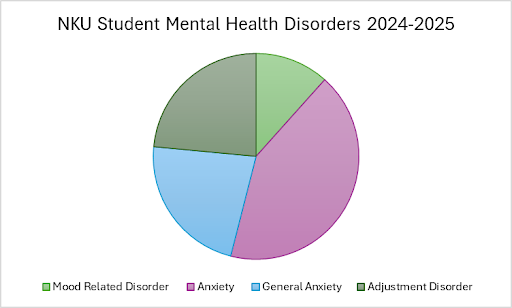 From 2024 to 2025, NKU saw high levels of students experiencing mood related disorders, anxiety and adjustment disorder. Combs said adjustment disorder is used to characterize students who are struggling with a situation and need assistance.
“In 2024 to 2025, 21.11% of the clients we saw were diagnosed with a mood disorder. 76.89% of our clients were diagnosed with anxiety. The majority are under the anxiety umbrella. That could be general anxiety, at 40.89%, phobias, social anxiety, panic disorder, OCD, PTSD, or something we call adjustment disorder at 42.67%,” Combs said.
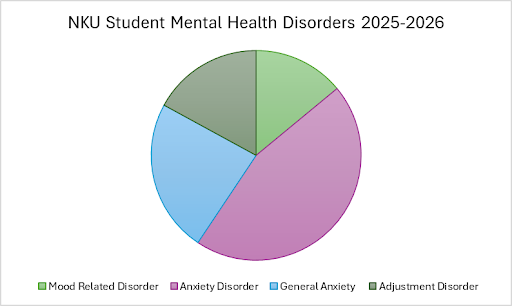 In 2025 to 2026 these numbers increased slightly, with adjustment disorders down from last year. Combs said this is likely because the NKU Counseling Service Center is seeing an increase in students coming in with more significant symptoms and seeking help on campus.
“For 2025 to 2026, 24.21% of clients were diagnosed with a mood-related disorder and 78.42% were diagnosed with an anxiety disorder. In terms of anxiety, 40.78% of clients had general anxiety and 29.48% had adjustment disorder which was down from last year,” said Combs.
Professors, friends and campus resources can play an important role in helping students manage academic stress when it becomes overwhelming. McCay says that reassurance and support from professors, in particular, can ease pressure related to assignments or exams and help students feel supported rather than defined by their grade.
“Professors can be understanding about that and can usually see that if you are trying. The exact percentage that you’re getting does not determine your worth,” they said. “Something that reduces my stress is trying to just help myself remember that at the very end of the day, I’m not my grades. My worth goes far beyond how I do in my classes or a grade on a specific final or test or midterm.”
McCay urges students to not be afraid to lean on others for support when dealing with your stress. It’s also important not to beat yourself up for procrastinating, missing an assignment, or receiving a poor grade on your final exams.
“Don’t be afraid to reach out… and don’t feel like it is a moral failing for being behind. I think we’re all human, and it’s important to remember that grades don’t define you,” they said.