

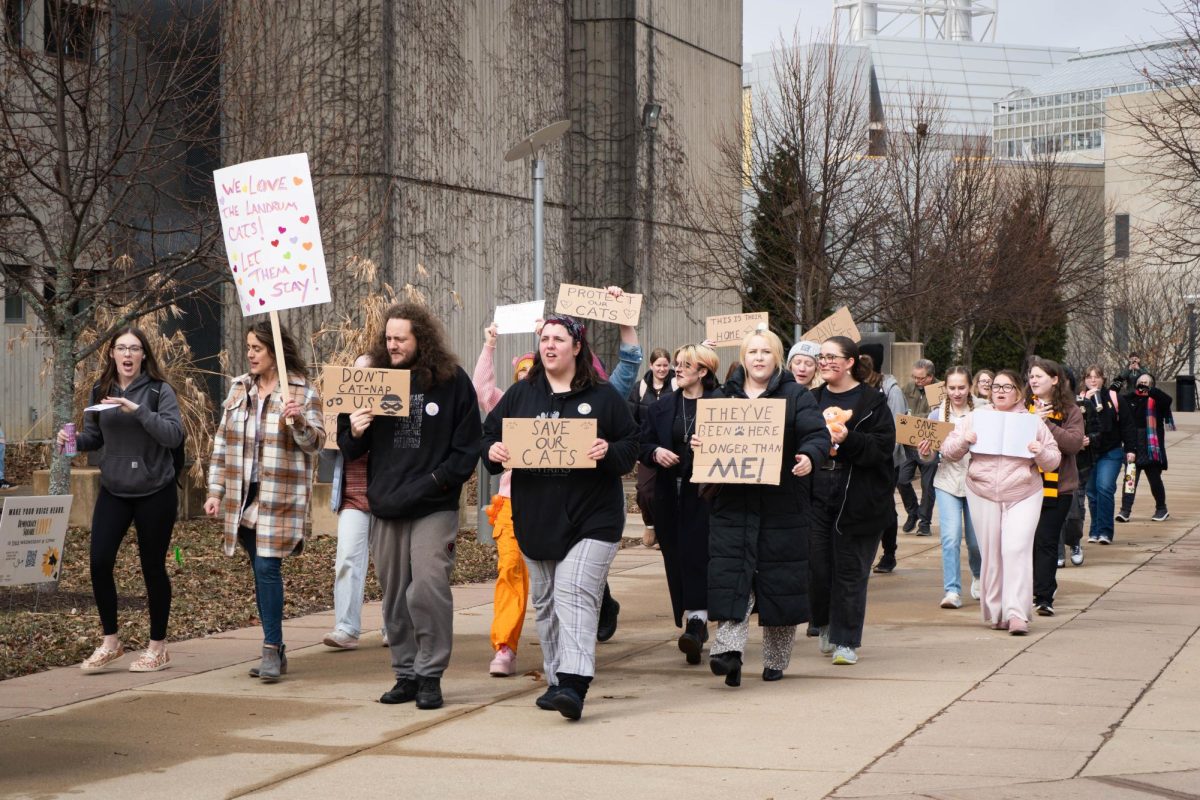
The scene was lively outside the Student Union on Thursday as chants of “Save our cats” and “Hey hey, ho ho, these cats don’t have to go” rang out across the plaza. A group of students, faculty and community members gathered in support of the cat colony living outside the Landrum Academic Center.
It has been a hotly discussed topic among students over the past week, as accusations of a Feb. 27 removal deadline led to widespread public outrage. The ongoing Change.org petition entitled “Save the Landrum Cats” has over 4,000 signatures.
While the university maintains the deadline is nothing but a rumor, and is allowing the cats to stay on campus until a permanent solution is found, they have confirmed that the cats cannot stay on campus.
Leading the protest was BFA student Rachel Paxitzis, who built and maintained the cat house at Landrum. Paxitzis acknowledged how large the community around the cats has grown.
“I think people are pretty surprised at the numbers and how vocal we are about this issue, but I think that’s the point,” she said.
While originally billed as just a protest, after talks with the university on Wednesday helped to ease tensions slightly, the event was pivoted to both a protest and a sort of farewell celebration of the cats. Paxitzis was pleased with the event, not only with the turnout, but also with the camaraderie among those in attendance.
“I think it’s wonderful to connect people. There are people here that I’ve not even met in person before,” she said. “It’s wonderful to put a face to a name that I’ve seen online. It’s a reason to develop a community, so it’s wonderful.”
On the university front of the situation, Tom Ramstetter, NKU senior director of internal university communications, sent out a mass email to the campus community early Thursday afternoon.
The email acknowledged the community’s advocacy and passion for the issue and also dispelled the rumors of a Feb. 27 deadline and the threat of animal control being called.
Also included in the communication was the following list of temporary guidelines, effective immediately, for the area where the cats reside:
Ramstetter reiterated the university’s position that it “cannot allow the cats to live in and around campus buildings,” but emphasized its openness to ideas being brought to the table. Including a web form for students, faculty and community members to provide “meaningful suggestions and ideas” on the situation to help move toward a “timely and thoughtful resolution.”
Paxitzis made clear that she understands the university’s perspective and is optimistic about the outlook of the situation.
“We are working right now to send some availability to the communications officer for the university, so that we can all sit down at the table,” she said, “not just me, not just Natalie [Brown]; the professors, the people that care for them, so that we can all have a conversation and talk about whats actually best for the animals and the university”