


Divisive policies, Immigration tensions and what many consider ongoing national crises, politics can have a profound effect on mental health, becoming a significant source of stress and decline.
According to a 2024 study by the American Psychological Association, nearly eight in 10 people (77%) reported that the future of the nation was the leading cause of significant stress and anxiety among adults.
Alongside politics being one of the leading causes of stress, trust in the government is also trending in the same direction. Down. According to a study done in December of 2025 from Pew Research, just 17% of Americans now say they trust the government.
Out of that 17% of Americans, 15% say that it is most of the time and 2% say it is just about always. That leaves 83% of Americans left with skepticism about the government. That distrust can lead to mental health effects.
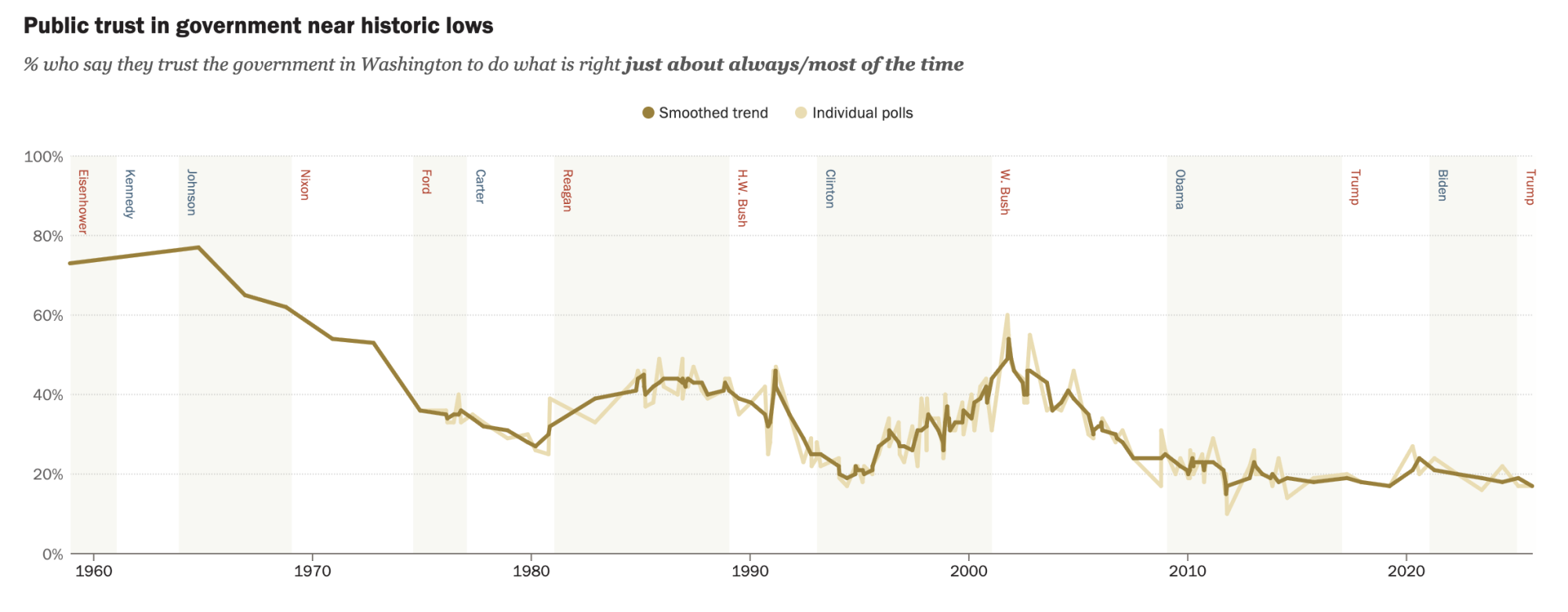
Sources: Pew Research Center, National Election Studies, Gallup, ABC/Washington Post, CBS/New York Times, and CNN surveys. (Pew Research Center)
How politics affects mental health
Dr. Jake Cowan, a political science professor at Northern Kentucky University, believes there is a trend of hyperpartisanship heightening this growth. He also believes that political rhetoric has been different during this age, a little bit more out there and unfiltered.
“You have social media where presidents say certain things, and I think people are concerned about their livelihoods and kind of from a mental perspective, because in political science, for example, we used to not really go into emotions or seem more as irrational,” he said.
Cowan isn’t an expert in the mental health field, but he knows it’s been on the rise. In the 90’s, he saw that leadership didn’t really discuss mental health; it was more on an internal battle where your family might help if there was something wrong.
After the Second World War, Cowan said, discussion of mental health issues became more normalized.
“We actually had presidents signing acts and things like that, to deinstitutionalize these people and kind of increase the use of psychotropic medication, antidepressants, things like that,” Cowan said. “It was, sort of, as opposed to people being stigmatized by political rhetoric. It was more okay.”
He sees that politics impacts individuals’ mental health quite significantly. Cowan looked at it through an economic scope, leaning towards healthcare.
“Current day, we’re looking at, well, does your health care cover you to go see a psychiatrist, to go see a counselor. How much money does your plan put into that? Can you afford it?” he said.
Cowan knows politics can be hard for his students as it constantly shifts. He keeps his classes open with healthy deliberation from both sides. Tailoring his teaching to his students is his number one goal, he said.
Dr. Rhonda Davis, an Interdisciplinary Studies professor at NKU, feels stress is on the rise because of global instability and a sense of aggression.
“We’re seeing a daily barrage of executive orders, firings, activity in immigration, like sweeping up innocent people, it’s at every front. It’s not just economic stuff or just environmental, everything’s under attack…So I think that those reasons give people a lot of concern,” she said.
Davis finds herself falling into the political rabbit hole often. When she feels the effects of it, she knows she has to step away from it right away.
“Hearing all the crazy, extreme tones, and that kind of stuff can have a negative impact on your ability to process information, and just give you a sort of a skewed view of what’s going on,” Davis said.
Dr. Christopher Lawrence, Director of Clinical Mental Health Counseling at NKU, said, at heart, we are emotional beings.
“Any kind of news can impact our emotions. People may experience sadness or worry or fear or hopelessness or anger or grief, despair, like all of that can impact us, according to the University of Michigan,” Lawrence said. “It can impact blood pressure, it can impact sleep, weight gain, weight loss, people may turn to substance use.”
Lawrence believes politics can also separate us from the other people in our lives. One emotion he feels that people don’t talk about often is contempt.
“When we hear it, it’s us versus them, rather than how do we figure this out? We set people into particular camps. And contempt is you look at the other side and you point a finger,” he said.
Protecting your mental health
Lawrence wants people to consider where they get their information from and how much a person takes in. He believes learning to engage the perspective of curiosity can help, but he also believes that you have to find things that enable you to feel good.
“Going out and playing pickleball, shooting hoops or going to a movie, something along those lines, things [activities] that…can help you feel good is beneficial,” he said
What Lawrence also finds beneficial is doing things that can help you feel like you’re making a difference.
“Volunteering or engaging in activities that you know connect to particular passions of yours…finding something that enables you to kind of look at yourself and say, ‘Hey, I made a difference today,’ that can give you more of a sense that you’ve contributed,” Lawrence said. “‘I might not be able to change the world by myself on this Wednesday, but I can make life better for this particular person.’ Like, what can you do to help somebody smile? What can you do to lend somebody a hand today and set a goal like that?”
Davis relayed a different message. Taking action. She noted that when people get down about things going on around them, they should attempt to change it themselves, which she believes can help.
She does believe that in her classroom, where her teachings focus on problems around the world, especially in the US, she can’t disconnect.
“You can’t just turn it off, because then you’re doing students a disservice,” Davis said. “You’re not looking at problems in the full scheme of things. So it’s really hard to disconnect.”
There is no definitive answer on how people can keep their mental health in check while staying informed; it varies from person to person. The first step to protecting yourself is being able to take a break from the political landscape and finding those things that make you happy.