


On a Saturday Night Live skit airing in March, a parody hospital prescribes its patients red meat and whey powder, in lieu of medicine and treatment. From refrigerators full of creatine to IV bags dripping with raw milk, the joke landed because it felt familiar: protein is suddenly everywhere.
Protein has popped up in fast-food chains, such as Starbucks’ protein lattes, and in grocery stores, with aisles stocked with protein-fortified cereals, popcorns and even soft drinks. Plenty of Americans are prioritizing protein, with 70% reporting protein as the nutrient they try to consume the most, according to the 2025 International Food Information Council Food and Health Survey.
Interest in the macronutrient has consistently been on the rise, with the number of “high-protein” products in the market quadrupling from 2013 to 2023, according to a study in Food Supplements and Biomaterials for Health.
“Every few years, there’s a different diet trend that everyone clings to,” registered dietician Kendall Hehn said. “At one point, everyone was obsessed with low-fat…or super low-calorie. These types of trends come in waves, and then it can get popularized by culture, especially with social media now. It makes it very easy to spread information; unfortunately, sometimes there’s misinformation.”
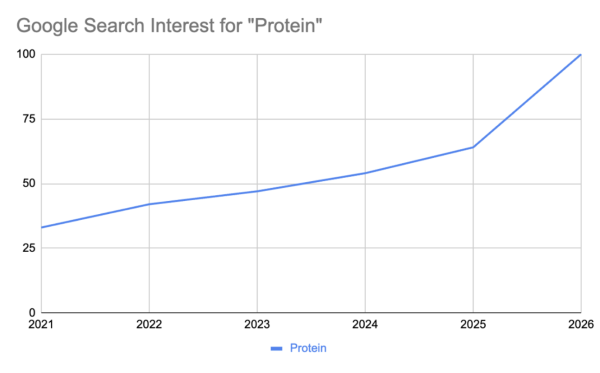
Social media platforms like TikTok and Instagram have played a central role in the popularity of protein, with gym culture and muscle-building content more specifically geared towards younger men. As Northern Kentucky University marketing and sports business major Noah Kahmann notes, it’s difficult to ignore the protein messaging.
“The gym community, the male influencers, they all push wellness and protein and just all that type of stuff onto you, per se, and if it wasn’t something that crossed your mind now, every time you go to the grocery store aisle, you think about it,” Kahmann said.
For decades, other macronutrients have shifted in and out of favor in popular culture. Fad diets, such as low-carb and low-fat, reflect how quickly macronutrients can be vilified. However, protein has been safe from these malignant depictions. Instead, it’s been elevated.
In the aforementioned SNL skit, a cast member acting as U.S. Department of Health and Human Services Secretary Robert F. Kennedy Jr. works in the fake “MAHAspital.” The name is a play on the slogan “Make America Healthy Again,” referencing Kennedy’s public initiative on the country’s health policies.
In January, Kennedy supported changes to the Dietary Guidelines for Americans, placing protein at the forefront, emphasizing meat and dairy. The updated food pyramid nearly doubles the previous recommendation for average protein intake. The original 0.8 grams per kilogram, or 0.36 grams per pound, is now 1.2-1.6 grams per kilogram, or 0.54-0.72 grams per pound of body weight per day.
While experts agree with the new guidelines’ suggestions to consume less processed food and added sugars, some have contested the higher protein amount, while also flagging concern for placing red meat as the principal source of protein. Alongside the emphasis on butter, beef tallow and full-fat dairy, the saturated fats from these foods could raise the risk of cardiovascular disease.
The updated guideline may benefit certain groups, such as older adults and those who are resistance-training. However, a population-wide recommendation of the new protein amount lacks substantial evidence and could lead to adverse effects, such as weight gain, according to a recent review by the National Library of Medicine.
For the average consumer, Hehn still recommends the original 0.8 grams per kilogram of body weight per day.
Hehn specializes in helping patients on dialysis, for whom increased protein intake is an important part of treatment, as the macronutrient lends itself to building muscle, healing wounds and fighting infections. However, protein consumption is rising in the general population, not just among those who are sick or bodybuilders. Aside from the burst in meat and dairy consumption, there’s also an increase in artificial protein.
“The artificial protein source that are coming from things like the protein popcorn, or adding protein to different things, there’s a very big marketing component to that that makes it seem like it’s actually high in protein, but it’s really not,” Hehn said.
As Hehn states, a lot of times, when eating the “high-protein” version of a product, such as protein Cheerios versus regular Cheerios, there is not much added benefit. However, the label can be appealing to consumers.
“These things are marketing-driven,” said marketing professor Dr. Aron Levin. “When low-fat came out, they’re like, ‘Oh, people need to lose weight. We’ll put real big ‘low-fat’ [labels],’ and what people didn’t realize at the time, they were pumping them full of more sugar. So it was like, yes, they were taking the fat out, but they weren’t really any healthier.”
This semester, one of Levin’s marketing classes at NKU partnered with Better Blend, a food and beverage brand known for its smoothies. With a location minutes away from NKU’s campus, the class goal was to find ways to grow the company’s Generation Z demographic. The franchise boasts clean ingredients with a focus on both animal and plant protein, straying away from artificial sources.
For the project, Levin periodically brought products into his class for students to try, such as protein-fortified sodas and pretzels, highlighting how common it is for consumers to opt for quick ways to consume protein rather than getting it from original sources.
“Companies have made it easier through the artificial powders and stuff like that, where it’s that easy way out than cooking a steak or making eggs… Where you can get that protein instead of having to wait 20 minutes cooking chicken,” marketing student Colin Press said.
As Levin says, the balance lies in juggling taste, price and how healthy a product is for the individual. Researching this trend for several semesters, Levin has noticed a bigger cultural shift toward interest in overall health, especially among Gen Z.
“A large segment of consumers are looking at their overall well-being, like how they feel physically,” Levin said. “We’ve been talking a lot about the connection between food and emotional and mental health… And they’re [young people] also thinking, ‘You know what, I want food that’s gonna sustain me, make me feel good, physically and mentally.’”
Although there is not much research yet on the impact of these high-protein diets, a concern in prioritizing protein is the possibility of missing out on other essential nutrients, particularly fiber.
While many Americans already meet the original recommended protein intake, most do not consume enough fiber. Less than 1 in 10 adults in the U.S. meet the daily recommendation for fiber consumption, according to the American Society for Nutrition. With the rise in colorectal cancer among young adults, concern for fiber intake is also growing, reinforcing foods that are more often dismissed in the American diet, such as whole grains.
The new inverted food pyramid notably places whole grains at the bottom and meat and dairy at the top, the visual ranking further accentuating protein in the modern diet.
“In any trend, it’s really just important to make sure you eat a wide variety of different foods, fruits, vegetables, sticking to the basics,” Hehn said. “I think a lot of people think that good nutrition is more complicated than it really is. But it’s actually kinda boring, and I think that’s why people don’t like it, because it’s not exciting or something new or something trending, but the basics have always been the same.”
As doctors flutter amidst the bustle of SNL’s “MAHAspital,” handing out platters of raw eggs and beef tallow to patients, a nurse replaces a poster of the old food pyramid with the updated one. The triangle entirely turned upside down, protein now takes precedence at the very top.