

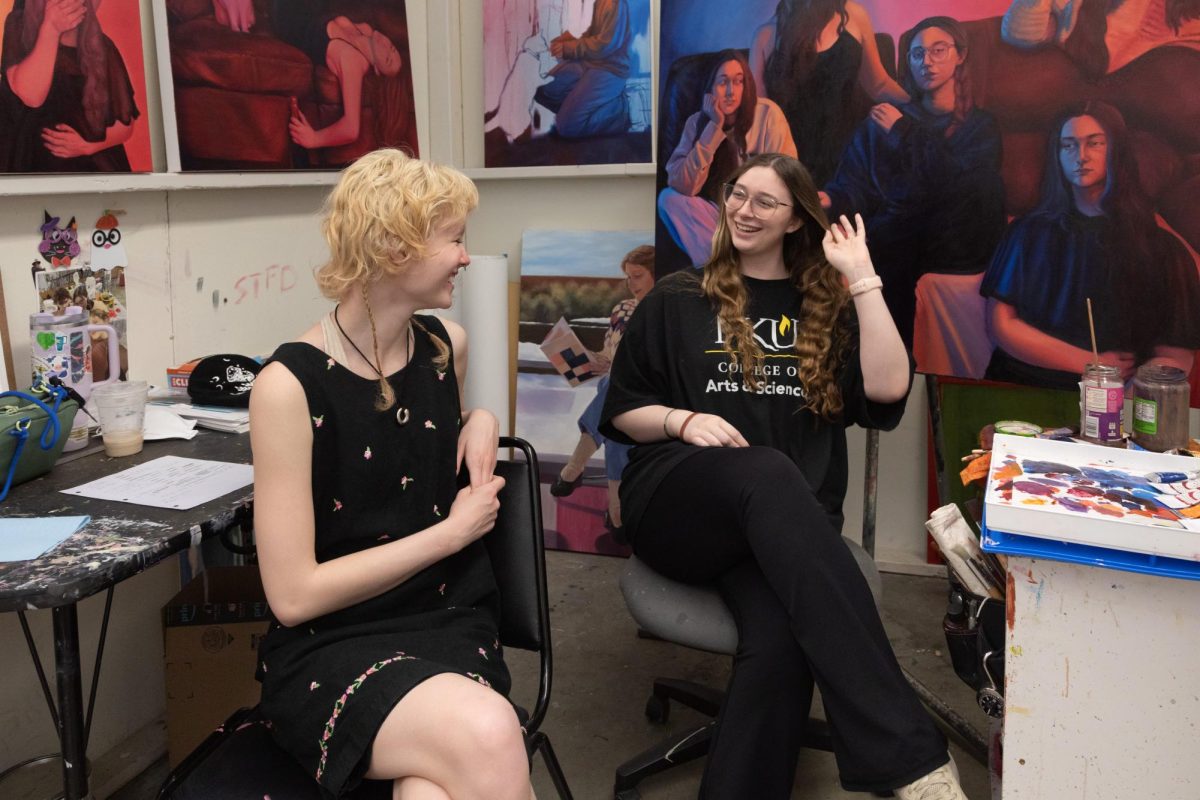
Nestled among the fourth-floor classrooms of Northern Kentucky University’s School of the Arts is a studio space dedicated to Bachelor of Fine Arts students. Two friends paint side by side, their workspaces bursting with color. Large canvases hang with oil-painted faces peering out. Tables are littered with errant pencils and splotches of paint; the tang of mineral spirits rests in the air.
“We started painting together; we’re going to finish it together,” said artist Sarah Roszell.
Sarah Roszell and Bri Wallace are both pursuing their BFA degrees in painting. Beginning April 16, their senior capstone shows will be on display alongside other exhibiting artists in SOTA. The two have been taking art classes together for four years, and are now finishing their degrees at the same time.
“There’s not a single piece of each other’s [artwork] that we haven’t seen or been there for throughout the whole process, and I think that in and of itself really pushed us forward in a way that not a lot of our other classmates have experienced,” Roszell said.
While working on their shows, Wallace and Roszell kept each other accountable by coordinating times to check in outside of class, encouraging each other to meet deadlines. Before starting a painting, they shared ideas, and after finishing a painting, they gave each other honest critiques.
“This is our degree,” the two said simultaneously.
Roszell’s show is titled “Radical Acceptance.” Washed in deep reds and purples, her paintings are crafted with only five colors. Her work is inspired by psychotherapist Babette Rothschild, who created a colored chart used in trauma therapy for regulating the autonomic nervous system. Each shade in the spectrum represents a different nervous system response.
“That chart is some way that I can make visible what’s happening in my body,” Roszell said. “And so my palette is a direct parallel to that spectrum. I’m giving the viewer a color key to decipher what’s going on behind the facade of my mask.”
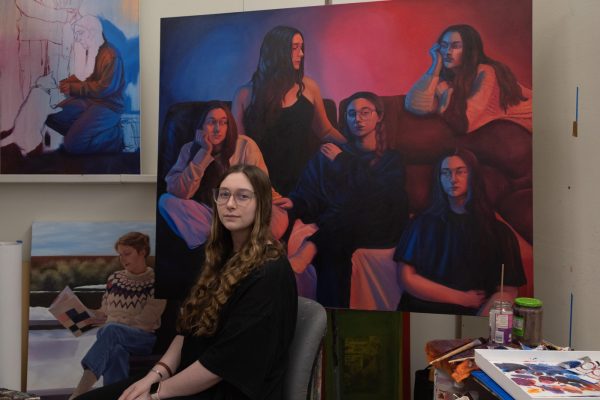
Addressing personal issues such as chronic illness, PTSD and sexual assault, Roszell’s show reflects her experience with Dialectical Behavior Therapy. The evidence-based therapy “helps reduce suffering experiences from trauma” and teaches coping mechanisms Roszell references in her paintings. Her artworks are mirrors; Roszell’s face appears on each canvas. Facial features arranged in apathy, but lit with vibrant colors, clue into the invisible struggles Roszell faces.
“When you self-insert, you’re taking back a control that you’ve lost, a bodily autonomy, in a way. Not only that, but you’re creating this community through shared experiences,” Roszell said. “And so when I include myself in self-portraiture, it’s often to not relive that experience, but bring it back to my own body in a way where I feel connected to myself again, and I can also advocate and bring awareness to those issues from somebody who’s lived it.”
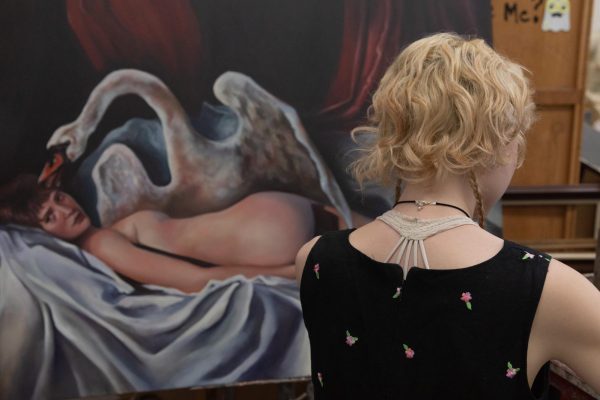
Merely a few feet away from Roszell’s space sit Wallace’s paintings. In one large canvas, fabric bunches around a reclining nude woman as a swan’s wings curve around the body. In the corner, a hairless cat rests its icy gaze on the woman.
Wallace’s show, titled “A Song for Leda,” is inspired by the poem “Leda and the Swan” by Irish poet William Butler Yeats. In ancient Greek mythology, Zeus disguises himself as a swan to rape Leda, a mortal woman. Wallace sees Yeats’ writing as a more empathetic interpretation of Leda, contrasting with the way artists have depicted the story in the past.
“Regarding [Leda] and her story, as well as other victims of sexual assault, it’s very much romanticized,” Wallace said. “So I’m taking aspects of the poem and the story and using it as symbols for my own experiences with sexual assault, and trying to deconstruct all of the misogynistic narratives of what it means to be a survivor.”
Like Roszell’s show, Wallace incorporates self-portraiture. Her own face looks out underneath the swan’s protective wing. Inspired by famous lounging women poses throughout art history, Wallace paints herself nude, hoping to push viewers out of their comfort zones and face the all-encompassing nature of sexual assault.
“The issue that I’m talking about is what it is. There’s no censoring it,” Wallace said. “And I think to skirt around it would be a disservice to myself and to survivors and to the issue. My work can be shocking, but it’s meant to be. If it wasn’t shocking, I would think I would be doing something wrong.”
Nearly half of women in the United States have experienced sexual violence in their lifetimes, according to the Centers for Disease Control and Prevention. Being an issue that affects so many, both Wallace and Roszell hope to help build conversation and camaraderie through traumatic experiences such as sexual assault.
“I want to make people feel less alone in the things that they’ve been through,” Wallace said. “And I think with me being so overt and bold and shocking about the way that I share my story, I kind of hope that it encourages others that it’s okay to be bold and it’s okay to take up space, and it’s okay to talk about the things that you’re told not to.”
Like their peers, Roszell and Wallace developed their shows over two semesters, culminating in the final BFA Senior Exhibition. On display in the galleries of SOTA through May 1, the two friends’ work explores similar themes, but each artist approaches them through a distinct visual language shaped by color, symbolism and experience. Similarly, each artist took something different away from the work they produced.
“For the most part, I made this show for me. This was about my journey and about who I’m becoming and being okay with that,” Roszell said. “It’s a memorial of myself, parts of me that I’m getting away, parts me that I’m keeping and parts me that I can’t let go of. Things that I wanted to say to myself but couldn’t, so I painted about it.”