

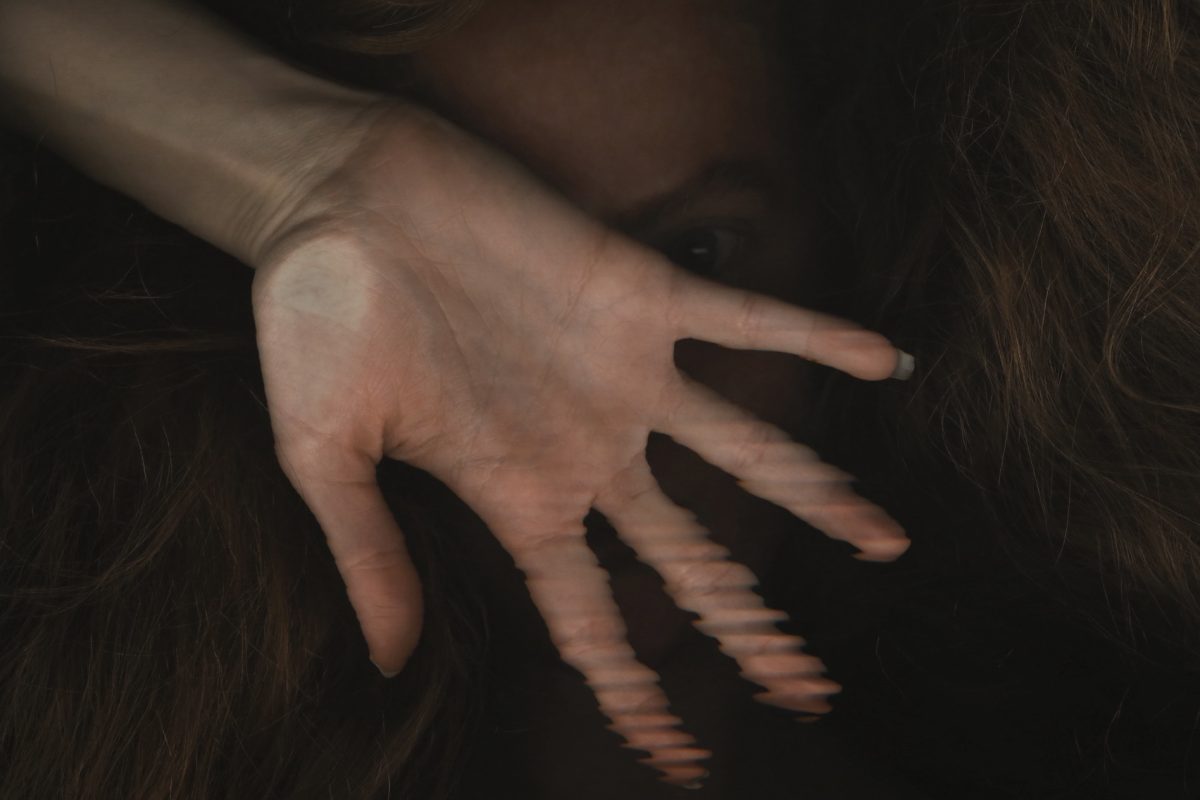
Hands twitch and glitch, obscuring the face. A digital dollhouse unfolds room by room, revealing delightful surprises. NKU’s School of the Arts faculty and staff exhibition, open through Feb. 19, features over 50 works by 21 artists. Professors, advisors and other staff members are offered an opportunity to showcase and sell their work.
The exhibit, titled “FE26: Art & Design Faculty & Staff Exhibition,” occurs during the spring semester of every other year. Alongside a solo exhibition by Visual Communication Design professor Julie Mader-Meersman, the galleries highlight the creativity of NKU’s own.
“I think it’s really important for students to see what they do,” Manager of Galleries and Outreach Paige Wideman said. “We’ve got some high-caliber artists that are running our programs and that are staying active in the field.”
Wideman curated the exhibition, bringing together a diverse collection of paintings, sculptures, photographs and more. With no given theme, the subjects and media vary.
Along the walls of the gallery reside three large images, arranged in a triptych-like way. Teaching professor Candice van Loveren Geis chose to display these pieces from a series called “Presenting As…”, a collection of scanographs of differing body parts commenting on the intricacies of self-identity.
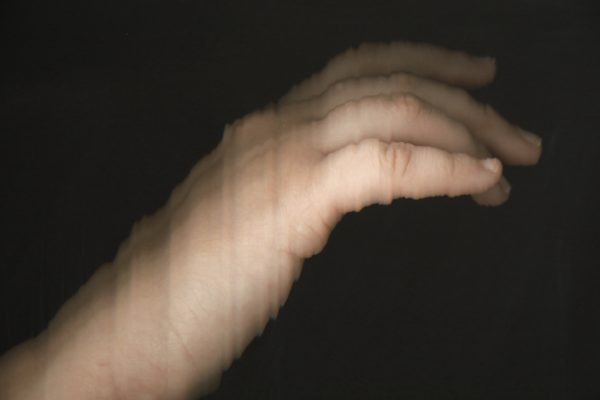
“This is actually my largest series, most personal content that I’ve ever exhibited and what I call the dirtiest images,” van Loveren Geis said. “I purposefully made them have that interference because they’re visual representations of my race and my family’s race and ethnic voyage to who we are now in America.”
In the largest scanograph, a hand is splayed in front of a face, the fingers glitching. The other two are similar, with a hand and a foot suspended in inky black. Using a scanner to produce flattened images without much depth, van Loveren Geis hopes to convey how people are given limited space to form their identities. Tackling her biracial background in her work, van Loveren Geis explores the implications of presenting as another ethnicity.
“It’s very complex,” van Loveren Geis said, “and it didn’t occur to me till I was an adult, the complexity of that situation and the privilege that I had by looking white…I have the privilege to present as white. But then if I don’t acknowledge that part of myself, who am I denying in my family?”
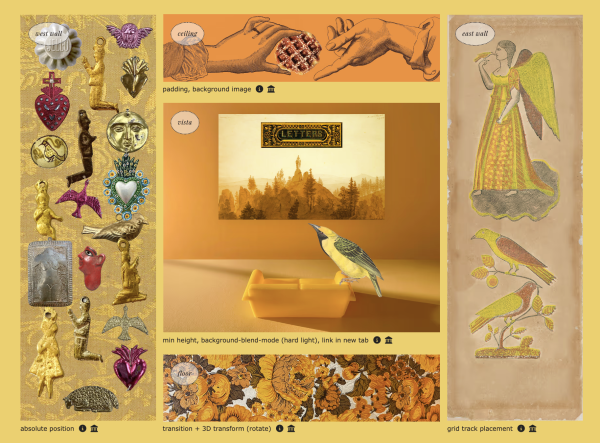
Beyond the main gallery, a different exploration emerges in Julie Mader-Meersman’s exhibition, titled “CSS Dollhouse.” Focused on the website created during her sabbatical in 2024, the CSS (Cascading Style Sheets) Dollhouse is an online tool for her upper-level classes to see unique ways they can utilize coding.
“I’m just really, overall, using all of this as a way to make learning the coding media side of the web more appealing for visual designers who can glaze over or get distracted by the code straight up,” Mader-Meersman said.
After her mother died, Mader-Meersman and her sisters recovered a box of old childhood toys. Feeling inspired, she took photos of them to use for micro-demonstrations in class. These lessons continued building until Mader-Meersman decided to work on an intangible dollhouse, finding it an apt metaphor for organizing the demos.
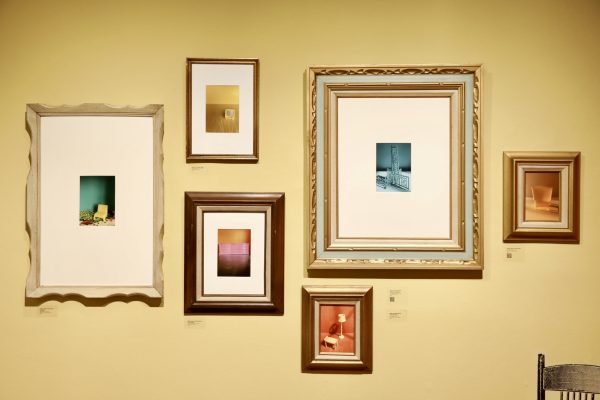
The dollhouse, with its funky wallpaper and whimsical knick-knacks, comprises 10 levels, each centered on a color scheme or theme. Its eclectic aesthetic is a conglomeration of original photographs and cyanotypes, paired with images sourced from the public domain. Many of Mader-Meersman’s pictures were found during her sabbatical, where she scoured places such as the Winterthur Museum, Garden & Library, using old drawings and photos from the 1800s.
“There’s a lot of beautiful things that, because they’re now in the public domain, people could resurrect,” Mader-Meersman said. “So I intentionally in the site included not just descriptions…But I also listed whether or not something is in the public domain, or if it is something I created.”
Many aspects of building the website came unexpectedly, spurred by strokes of luck. When photographing a piece of doll furniture, for example, she noticed the way the light glinted into the room, illuminating the yellow plastic sofa. Mader-Meersman was inspired to make a chapel.
“The light moved me to take that shot, and I built the whole room around the color of that moment,” she said. “I had many surprisingly moving moments during the sabbatical…the depth there with the time investment was really valuable creatively.”
Mader-Meersman’s sabbatical exhibit is presented alongside the bigger show in the main gallery. Both exhibitions will remain open until the closing reception on Feb. 19 from 5-7 p.m., held in SOTA’s galleries.