

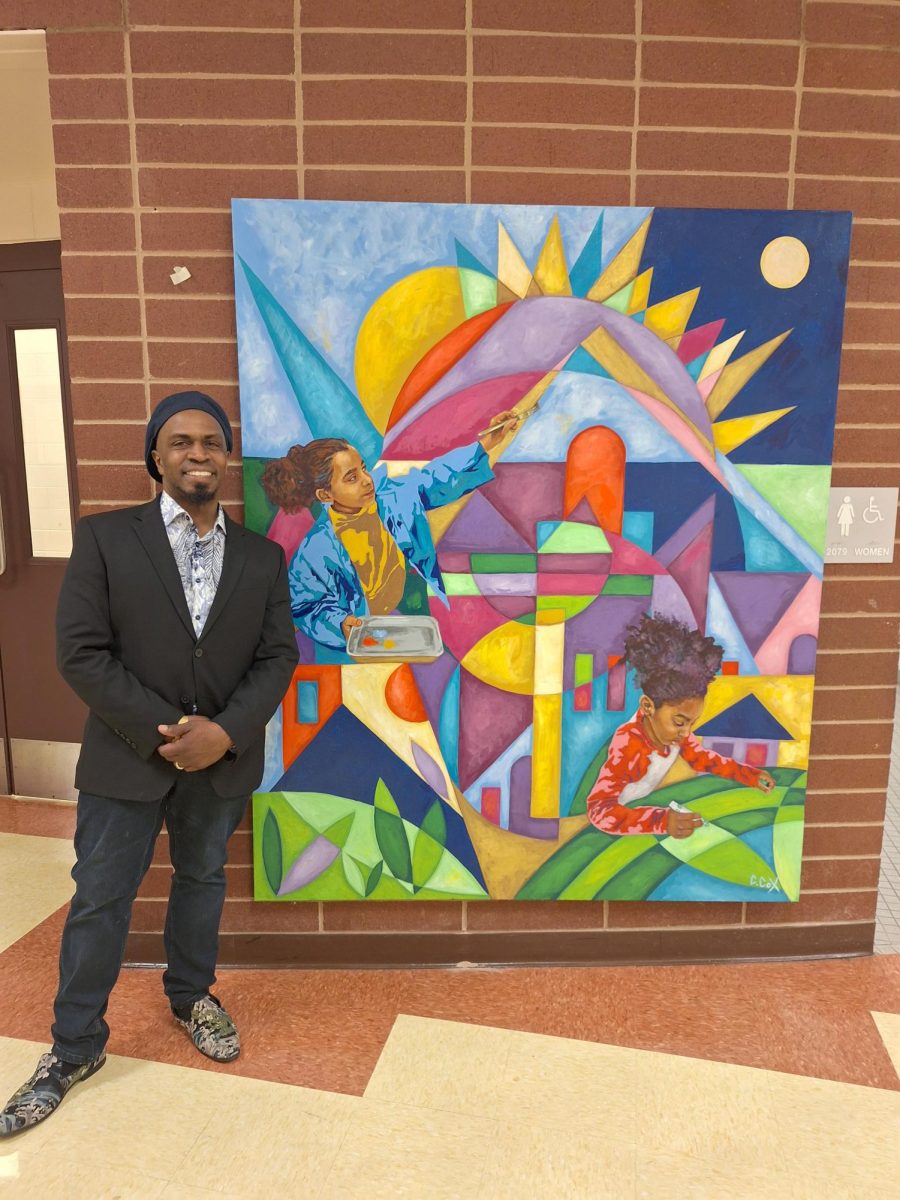
In third grade, Cedric Michael Cox approached his father with a still life he drew in class. He worked hard trying to get the forms just right. His result wasn’t perfect, but it was bold and abstract. Instead of correcting young Cox, his father reached into his immense collection of all the greats and pulled out a Time-Life book on Picasso. He assured his son and encouraged his abstractionism. Soon after, Cox’s father framed the drawing—a small gesture, but one that left a profound impact.
“My dad just taking the time to frame it,” Cox said. “You know, that was one of those positive reinforcements that kind of happened in my life to make me … realize people are watching what I’m doing as an artist, and they care about the journey as much as they care about me painting.”
Today, as a prominent local artist, Cox continues to unveil his interpretation of the world around him in his own artistic language. Throughout his career, he has appeared in collections and galleries across the region and has dedicated himself to teaching the next generation of artists.
“Everyone really just loves Cedric and his energy,” said Ellen Muse-Lindeman, executive director of the Kennedy Heights Arts Center. “His enthusiasm is infectious. He really has a way of recognizing the creativity in everyone and helping pull that out.”
For well over a decade, Cox has led youth and adult art programs, summer camps and mural projects at Kennedy Heights that have helped countless artists find the story they want to tell.
From painting seasonal promotions on Kroger’s storefront windows at 17 to headlining exhibitions, Cox stands as a reminder to students that growth requires flexibility, persistence and self-direction.
As an artist and an educator, Cox’s path began with his parents. His mother was a schoolteacher. His father worked at mercantile stores and was a salesman at McAlpin’s. However, when his mother’s lesson plan required some artistic input, his father was an illustrator. When the house needed some decor or rearranging, he was a designer.
“He had a real sense for design, color and composition in a sense of how he decorated our home, how he set up in floor plans,” Cox said. “I remember him drawing a lot and then me, you know, just at the kitchen table drawing, and him just observing and critiquing and stuff. So, it was cool.”
In those early years, Cox’s sketches were what you’d expect of a child—action movies and superheroes. But the foundations of his creativity were already present.
“Even as a child, there was always this level of the foreground and the background having the same intensity,” he said. “Not necessarily really what I was creating, but how shapes and parts move within the pictorial arena was really what it was all about.”
In high school, Cox discovered his art could act as a bridge to people, his form of connection.
“I think art was that barrier [breaker] that allowed kids to ask me, ‘What are you doing? How did you do that? Can you draw this for me?’” he said. “It became my badge of honor…part of my character.”
Across the street from his home in Kenwood, Cox carried art to the workforce, painting window signs at the Kroger grocery store.
“It was cool just communicating with different kinds of people, different walks of people within the working environment and just being…a part of the visual elements to make it unique,” he said.
When it came time to graduate and choose between pursuing choir or art, his inability to dance, as he joked, made the choice simple. He enrolled in the University of Cincinnati’s College of Design, Architecture, Art and Planning (DAAP).
“I heard DAAP was really cool,” he said. “I just went for it. Just said, ‘hey, let’s give it a shot.’”
When his late professor Marty Tucker suggested he apply to study at the Glasgow School of Art in Scotland, Cox ‘went for it’ again. It was there that he was taught an important truth beyond the canvas.
“Be aware of who you surround yourself with…that you’re around positive energy…encouraging you to keep doing what you’re doing,” he said.
He carries that message to students who are hard at work paving their own path.
“You take on the character of your environment, and you have to be very mindful of that,” he said. “That’s the best advice I have for students.”
Mary Heider, former assistant dean of the University of Cincinnati College of Medicine, attended Cox’s first art show around the year 2000 and has been admiring his work ever since. After retirement, she set forth on a mission to beautify the walls of the college. Cox’s work did just that.
“You can tell this work changed that space, and that’s what’s important. That’s what a good artwork does,” Heider said.
After his time studying in Scotland, Cox returned to UC with a new goal in mind. To evolve, he needed to go back to the basics.
“I realized I was gonna take advanced drawing as a way of understanding more about the work that I was making. Drawing in that classroom is not necessarily about pen and paper,” he said. “[it was] developing a sense of gathering information…towards your subject.”
That class, full of sculptors, ceramicists and printmakers, revealed a new way of creating and defining art for him, opening his mind to other options.
“I really wanted to really understand the forms that I’m creating,” he said.
This marked a transition for him, one that would be “void of color”.
“When I poured my paints down the sink…I realized, I gotta take it to another level,” he said. “That’s when I picked up that pencil and started unrolling these large sheets of white paper and just going to town…That’s when my forms started to come [to] life,” he said.
Some of those large-scale drawings, “reflective of that time in college,” were displayed in his exhibit “Charismata” at the Xavier University Gallery. The basics that breathed life into his work shaped the artistic language he uses today. His language is derived from themes he already knew existed within him.
“I had an instructor always telling me to paint what I know,” he said. “What I knew at the time was me playing bass, playing guitar and then having those elements within my work because it was such a big part of my subconscious ideas and thoughts.”
Musical elements play a key role in Cox’s creations.
“Music has curves…curves are friendly,” Heider said. “They’re not threatening…they take you someplace and let you wander off and relax or think.”
At graduation from UC, Cox wasn’t handed a rock-solid career along with a diploma. He dove straight into art education; he worked at an electrical warehouse and a marketing firm. While he had a day job, he committed to overtime in the studio.
“It wasn’t like, ‘okay, I get out, let’s try to get into galleries.’ No. You work a nine-to-five. You work a job. And then you work your career after the nine-to-five, after the job,” he said. “That means five to six hours every day in the studio, motivating yourself to create.”
However, while working at the warehouse, he still found ways to connect to the arts.
“I started…curating art exhibitions and creating these…multimedia kind of, you know, extravaganzas,” he said. “We had our own ideas of uplifting the culture through the arts and put on this thing called the Urban Arts and Cultural Festival. And we had various out-of-town artists, musical artists, creators; we curated our exhibitions.”
Commitment to the arts, no matter what the strategy, is a reason for his success. To soar, he pushes his own curiosity.
“When I’m adding a vase, adding a still life, adding a Northern Star Quilt pattern, adding these different elements…they’re creating different genres than my style, but they’re just to keep the interest going,” he said. “That’s what the game plan is, to keep the interest going.”
The variation in his artwork translates to his willingness to have variation in his career.
“I would tell my younger self to be flexible…be prepared to accept and say yes to everything…be able to step out of your comfort zones and apply and to reach out more and actually ask yourself, ‘where do you want to be?’” he said.
What pushes Cox to create comes from within. That realization came from advice given to him by a professor.
“‘No one cares whether you make art or not. You have to care,’” he recited.
Ellen Muse had the personal experience of watching Cox bring out the “creativity and…love for making art” in her own son and daughter.
“I think he’s probably, without a doubt, one of the most influential art teachers they’ve had,” Muse said.
That same ability to inspire others stems from the conviction Cox built within himself. This gave him a reason to commit day after day.
“I did not want to be an art school casualty…I knew I had something special, and all I had to do was keep doing it…I knew I was hot, man. I knew I was good…the big struggle was just making sure I just do it,” he said. “Because if I do it, I’m gonna win.”