

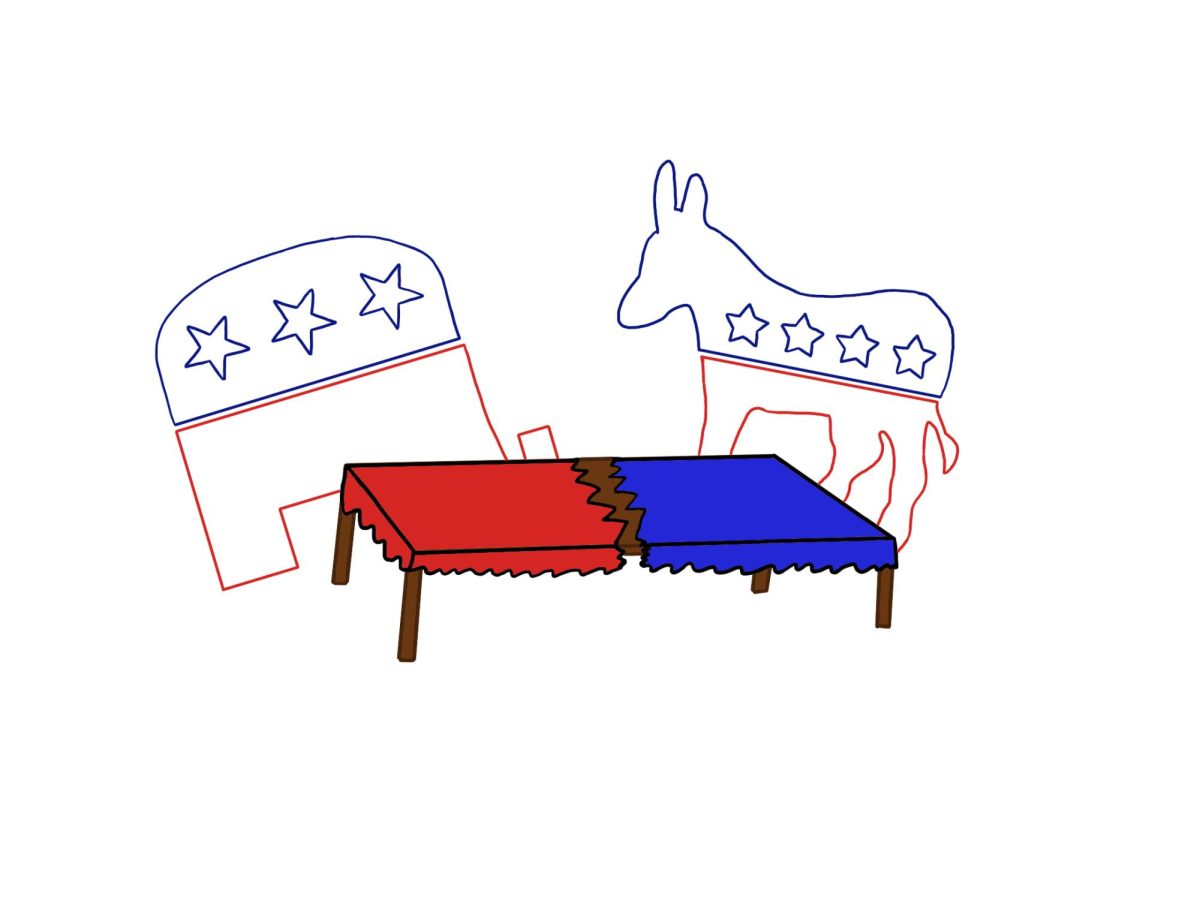
Gathered around the table but not gathered in political alignment, a family sits together to celebrate the holidays. They dance around topics as the candlelight dances across the slowly dimming room.
Political partisanship, driven in part by the U.S.’s two-party system, provides the two named sides to this disagreement.
As NKU political science professor Dr. Shauna Reilly explains to her students, partisanship is like looking through a particular pair of sunglasses.
“If you think about putting your conservative glasses on or your liberal glasses, and if you only filter everything out that doesn’t belong to that, it just reinforces and polarizes you more,” says Reilly.
According to Gallup, the number of people who self-identify as moderate has dropped from 43% to 34% from 1992 to 2024. Additionally, Gallup polling has shown that the number of Republicans who identify themselves as very conservative has risen to a record high of 24%. The number of Democrats who identify themselves as very liberal has also reached a record high of 19%.
History of polarization in the U.S.
Polarization is not new to the world or the U.S., but rises and falls with time, always present in some capacity.
The Civil War was one of the earliest defining instances of polarization in the U.S.. Fought over slavery, initially the expansion of slavery, but later for its abolition. Even though the war took place in the 1860s, it remains the deadliest war in the nation’s history. A legacy of racism and political division remains to this day, directly tied to the conflict.
During the early to mid-1900s, two instances of Red Scares fostered polarization and fear across America. Red Scare is a term used to refer to public moral panic about communist and socialist ideas, with red as the color that represents communist ideas.
Later in the 20th century, public opinion on the Vietnam War varied greatly, driven by anger about the draft, concern about the South Vietnamese government’s corruption and worries about communism.
Impacts of social media on polarization
Media algorithms feed users content based on what they engage with most, showing them more of what they want to see.
This can add to the layer of sunglasses that someone is already wearing, most commonly referred to as an echo chamber. Content that comes up on someone’s page as they scroll throughout the day likely reinforces whatever views they may hold, incentivizing them to continue scrolling while simultaneously building their walls higher.
A study on the Welfare Effects of Social Media of 2,743 Facebook users showed that those who gave up Facebook use for a period reported a significant reduction in polarized views.
Can we compromise?
Political philosophers have long examined the ideas behind the morality of compromise, and there will never be true agreement about what is and is not morally right.
In an article in the Political Studies Review journal, Friderike Spang argues that there is a difference between consensus and compromise. He points out that in compromise, one does not necessarily give up one’s views; they simply agree to do something for common interests. Whereas consensus requires that one change their position on a view that they hold.
Most political discussion falls under the category of moral compromise. It is argued by Florida State University philosophy professor Dr. Simon May that moral compromise is only justified when it is for a pragmatic purpose. That is, when the compromise contributes to some sort of necessary change.
One issue with the discussion on compromise is that it assumes that there is one universal truth and that compromise is being made based on these truths. In the current U.S. atmosphere of misinformation, this is not an assumption that can be made. Reality cannot be compromised, as a compromise is based on subjectivity, whereas reality is objective. This does not necessarily mean that one will be able to get all parties to agree to the objective truth.
At the family dinner table, however, one does not need to reach a compromise or consensus. Pragmatic compromise is unlikely to be obtainable at a table of people who are not in political office. However, it is worth considering in these conversations how one thinks and responds to others’ ideas.
A professor’s advice to students
Reilly does not see polarization as a reason not to have these conversations around family, but rather something to consider in approaching these conversations.
She recommends, “trying to find the middle ground or a topic you do agree on or listen to understand, not to respond.”
To find civility and respect at the holiday table, Reilly suggests that students bring exactly what they learn in the classroom right into their homes. You can try using the civil discussion skills you so often practice in class and remembering how you relate to classmates you don’t know.
Relating with someone can include bringing up content you might be more likely to agree on, not necessarily veering away from politics entirely. Problems are still problems, no matter what sunglasses you are wearing.
When asked what final words she would offer to students, Reilly turned to openness as her overarching advice.
“I think it’s easy to fall into the trap that your own opinion is right and just being open to conversations with folks that don’t share that opinion about anything is worth doing in a constructive way, not just for the sake of argument,” Reilly said.