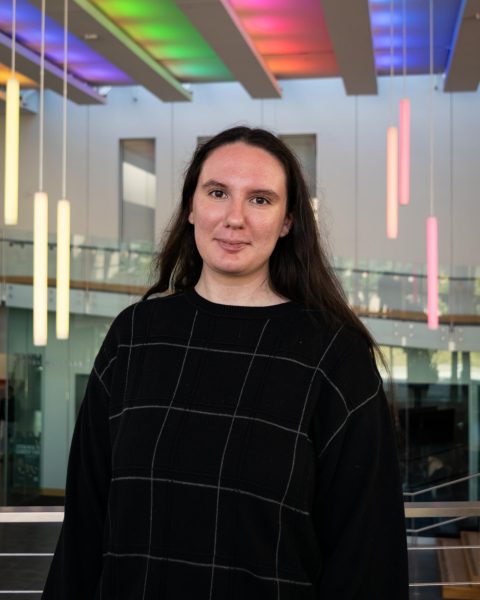
As a senior about to graduate with a minor in American Sign Language (ASL) and Deaf Studies, I’ve learned so much about the Deaf community, and it’s opened my eyes to how the world can change by giving them more accessibility.
While I am not fluent in ASL, I know enough that when I listen to music, I find myself signing the lyrics.
The reason I decided to get the minor was because I thought it would be easy, while also giving me the chance to learn about a language I barely knew anything about. However, that quickly changed when I took Beginning American Sign Language (ASL I) and Deaf Culture and Community.
Learning about Deaf culture made me realize that there is more to the Deaf community than many people know.
September is Deaf Awareness Month, an important time for the Deaf community, when people can be informed about their culture, language and diversity.
It draws attention to the distinctive challenges Deaf people regularly face with access to healthcare and public services, such as getting interpreters, getting an education and securing jobs.
For example, going to the hospital can be difficult for Deaf people as it can be hard to get an interpreter, whether it is in person or over Video Remote Interpreting (VRI). Sometimes, Deaf people never get an interpreter, so they are forced to write down what they want to say and lip-read to understand what is being communicated to them.
It is much harder than it should be to get an interpreter in these cases. But, how else are they supposed to explain to a doctor in the emergency room what they are feeling and their pain level?
The issue is also complicated by the large number of different types of sign language around the world. In the U.S., we have American Sign Language (ASL), but there is also British Sign Language (BSL) and French Sign Language (LSF) as just a few examples.
There are different ways people become deaf. Some become hard-of-hearing later in life when they are older, some are born deaf and some become deaf due to an illness or injury.
In the Deaf community, it doesn’t matter when or how you became deaf or how bad your hearing is; whether you are hard-of-hearing or deaf, you belong.
Getting an education used to be almost impossible for Deaf people. There was a time when people thought those who were deaf didn’t need an education because they could not hear, and the only way people could learn was through oral instruction.
I am currently taking Deaf History in America and just read the chapter in our textbook, “The Deaf Community in America: History in the Making,” about the growth of education for Deaf people, and it was the most interesting thing to learn about so far in this class.
The amount of work that was put into just giving Deaf people the opportunity to get an education is astonishing.

To any students who are interested in learning more about ASL and/or Deaf Life, NKU has an American Sign Language and Deaf Studies Minor in which students can take four ASL classes and three Deaf studies classes: Deaf Culture and Community, Aspects of Deaf Life, and Deaf History in America.
The three deaf studies classes are only offered online. In these classes, you learn more about Deaf life and history. In the ASL classes, you learn how to use sign language. Those can be taken online, but it is highly recommended to take them in-person.
Students who do not want to get the full minor and just want to learn ASL, can get a micro-credential by taking the first three ASL classes.
Another thing students should know is that the professors who teach the ASL classes are all deaf. On the first day of classes, there is an interpreter, but after that the professor is by themselves.
I remember the first day of my first ASL class and my professor walking up and beginning to sign, with an interpreter behind me translating what she was saying.
The first thing I thought was, ‘Oh no, how am I supposed to be able to learn ASL if my professor can’t hear me?’ But the total immersion process works for ASL like it does for any language.
As students learn more ASL, it becomes less difficult to understand the professor. The students can even pick up on a few signs they haven’t learned yet in class.
In the ASL classes, students are required to get five ASL hours to immerse themselves in the deaf community. A popular way students have gotten their hours has been attending NKU ASL Club events.
There are coffee chats where students meet outside the Starbucks in the Student Union and sign the entire time about anything–the classes they are taking, how the semester has been and any signs they want to learn.
Game nights have become quite popular, with UNO being played and no talking allowed.
As the President of the ASL Club and a student completing the program this semester, I highly recommend taking the minor if you want to learn ASL and learn about the Deaf community, its culture and history. I have learned so much in the two years I have been taking the classes.
But if students are too late to complete the minor, just attending the ASL Club events is informative and can allow them to learn a few signs.
Deaf Awareness Month is a great way for people to learn more about deaf struggles, but also their successes and what they have done to get them to where they are today.